
Participating in an international group visit to your own hometown offers a unique opportunity: to hear how others see a place you know well, and in turn, to see your own city anew.
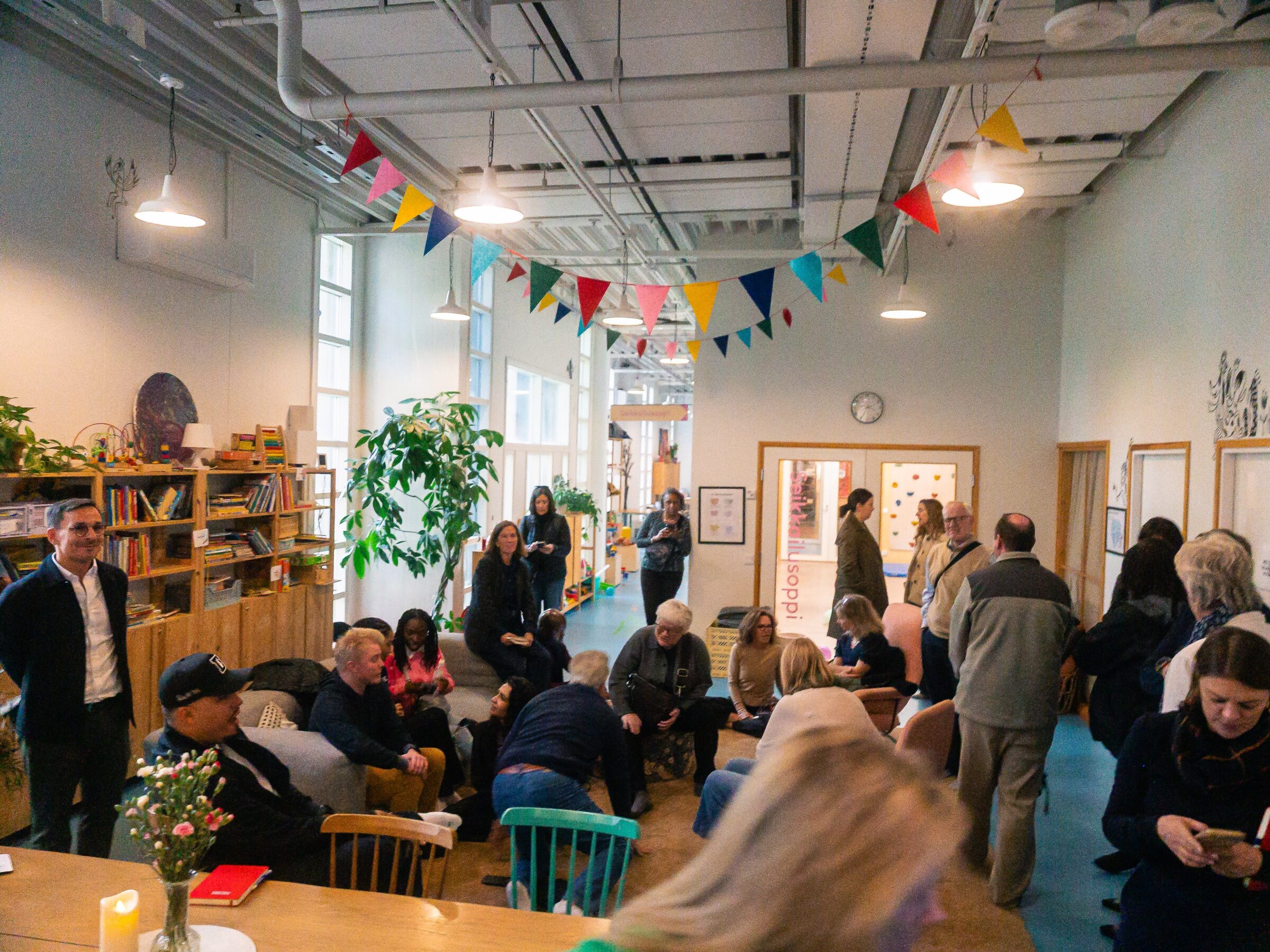
I had the privilege of spending two days in September with a delegation led by The Gambrell Foundation in Helsinki, serving as both participant and co-host. The visit focused on learning, hobbies, and equal opportunities among children and young people, or in a word, care.
Observing how care plays out in practice—in schools, clubs, and other everyday environments—left me both uplifted and questioning: Is our understanding of care too vague, too ‘soft’? Can we invest in infrastructure for care the way we invest in bridges and power lines? Do we even know what such infrastructure would consist of?
Even though there may be no definitive answers, Helsinki offered compelling and, above all, inspiring possibilities.
***
Helsinki showed its sunniest side when the group visited City Hall to hear Mayor Daniel Sazonov present the city’s newly completed strategy.
The strategy process had been remarkably swift yet achieved broad consensus. The document, entitled “Helsinki We Can Be Proud Of,” highlights a key objective: tackling inequality and preventing segregation.
However, even a well-crafted strategy would have little impact without the underlying political culture to support it. Finland’s multi-party system makes working across party lines essential. This cooperation is especially pronounced at the city level, where there is no government-opposition divide in the coalition-based city council.
It’s no coincidence that the strategy focuses particularly on children and young people. Polarization is intensifying throughout society, but Finland has a history of finding common ground even amid major conflicts—often to the benefit of its youngest citizens.
In today’s climate of identity politics, the lessons previous generations learned about building consensus and valuing practicality remain Helsinki’s strength.
***
From City Hall, the journey continued to Helsinki’s suburbs. Maatulli Elementary School is one of the city’s most multicultural schools: almost half of the students speak a language other than Finnish, Swedish, or Sámi as their mother tongue. In a country where immigration is relatively recent, the school’s diversity offers a glimpse into Finland’s increasingly multicultural future.
Our teacher hosts didn’t shy away from discussing learning challenges or difficult everyday situations. Everything conveyed an unyielding can-do attitude, a determination to make the school the best possible place to learn.
This attitude stems directly from autonomy. In the Finnish education system, teachers have considerable independence in deciding how to implement the curriculum and manage their classes. Neither teachers nor students are evaluated through continuous testing. Granting autonomy is a sign of respect.
This trust was evident at Maatulli. When the city decided to build a new school building, teachers and students saw it as an opportunity to influence not only the design but also the school’s entire curriculum and collaborative working methods.
The school’s motto—”Learn, think, get excited, and enjoy”—would serve many workplaces well.
***
The Finnish welfare state is built on a strong public sector, with philanthropy playing a traditionally different role than in the United States.
Support for the welfare system is strong across Finland’s political spectrum. At the same time, nearly everyone recognizes it is becoming expensive for a rapidly aging country with sluggish economic growth over nearly two decades.
New forms of cooperation are helping address these constraints. One particularly successful example is the long-term partnership between the City of Helsinki and the We Foundation (Me-säätiö) in providing recreational opportunities for young people. The We Foundation was established by the founders of gaming company Supercell as a way of giving back.
A visit to the We Foundation’s Me-talo Meltsi, a youth center in the suburb of Mellunmäki, demonstrated how a private foundation can strengthen public sector work—not only through concrete action but also by providing research on the lived experiences of children and young people.
The staff of the foundation presented a model being developed to measure the impact of hobbies. It clearly showed that resources extend far beyond finances: they include knowledge, technology, and creative approaches.
***
Attentive readers may have noticed that an acronym has emerged: Consensus, Autonomy, and Resources are joined by E for Empowerment—which, after the experience at Me-talo Meltsi, required no forcing.
At Me-talo Meltsi, Irma Sippola, project manager from the city of Helsinki, explained The Finnish Model for Leisure Activities in Helsinki. The idea is simple: enable every child and young person to have at least one hobby, regardless of background or family finances. The hobbies are offered free of charge in school facilities after school hours.
When Sippola described how hobby providers are selected, she emphasized giving power to young people themselves. “We always say the same thing: what the kids and teens want, we make it happen.”
Empowerment isn’t fluffy encouragement or a pat on the back. It’s about enabling people, even minors, to make decisions about their own lives: transforming them from objects to subjects.
That is precisely why empowerment may well be the strongest and most sustainable component of a society striving for inclusivity. And that alone is surely why infrastructure for care is worth investing in.
***
My heartfelt thanks to The Gambrell Foundation and Tommi Laitio of Convivencia Urbana for the invitation!